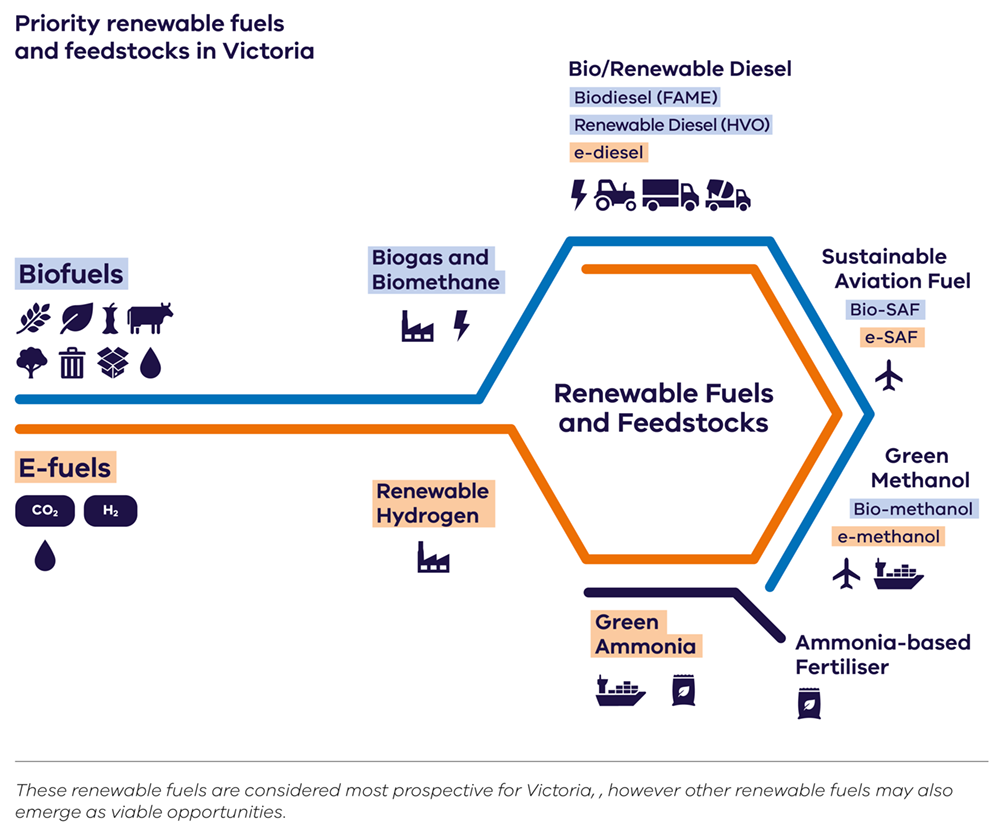
Renewable fuels are liquid and gaseous fuels produced from sustainable resources such as wind or solar energy, sustainable water and agricultural and waste feedstocks, rather than finite fossil fuel resources.
Examples of renewable fuels include renewable diesel, biodiesel, biomethane, sustainable aviation fuel (SAF), green methanol, green ammonia and renewable hydrogen.
Biofuels
Biofuels are produced from renewable biogenic feedstocks. Feedstocks include agricultural waste (residues), seed oil, commercial, industrial, wastewater treatment and municipal waste streams.
Examples of biofuels include biodiesel, renewable diesel (HVO), biomethane, and biogenic SAF.
E-fuels (or synthetic fuels)
E-fuels are produced when renewable electricity is converted into renewable fuels (often referred to as power-to-x or power-to-liquid). Renewable hydrogen can be used directly as a fuel and is also an important feedstock used to produce other renewable fuels.
It can be combined with nitrogen or a carbon source, such as biomass, or carbon captured from the atmosphere or industrial processes to produce other e-fuels. Other e-fuel examples include green methanol (e-methanol), renewable diesel (synthetic or e-diesel), SAF (power-to-liquid pathway) and green ammonia.
The role of renewable fuels
Renewable fuels are anticipated to play an increasingly important role in a secure, low-emissions energy system, supporting sectors where electrification is difficult, impractical or not feasible while strengthening economic resilience and energy independence.
Their development can support emissions reduction, energy system resilience and economic opportunities across the state.
The Victorian Government recognises the important role of renewable fuels and sustainable feedstocks in supporting the state’s economy and transition to net zero by 2045.
Decarbonising hard-to-abate activities
Renewable fuels are expected to play an important role in reducing emissions in sectors where electrification is not viable such as aviation, shipping, some heavy and long-haul road and rail freight and some high heat industrial processes.
Renewable fuels can also support decarbonising our electricity system through peaking and back-up power generation.
Strengthening fuel security and independence through local production
Local renewable fuel production can reduce reliance on international supply chains, while biomethane may contribute to future gas supply.
Leveraging Victoria’s existing infrastructure and feedstock base can improve reliability of the energy system and help diversify Victoria’s energy supply.
Driving investment, innovation and regional growth
The sector has the potential to unlock economic benefits, attract investment and create jobs in regional Victoria. It also offers new income streams for feedstock producers and supports long‑term industrial development.
Feedstocks are raw materials or other inputs used to produce something in an industrial process.
Renewable fuels can be produced using a range of sustainable feedstocks, including agricultural waste (residues), commercial, industrial, wastewater treatment and municipal organic waste streams, oilseeds, water, and renewable hydrogen as an intermediate input.
Understanding the type, location and volume of feedstocks is critical to identifying opportunities for renewable fuel production while balancing environmental, land-use and circular economy considerations.
Victoria’s biomass resource
Victoria’s diverse range of sustainable feedstocks present a strong opportunity for renewable fuel production. A key consideration for renewable fuel development is the availability of sustainable feedstocks.
Understanding the type, location and volume of feedstocks is critical to identifying opportunities for renewable fuel production while balancing environmental, land-use and circular economy considerations.
The Victorian Government is supporting the production and use of renewable fuels through a range of initiatives and considering future policy options that could complement national policy settings and guide the sustainable development of a thriving renewable fuels sector.
The Victorian Government has supported the development of datasets identifying potential biomethane production opportunities and renewable fuel feedstock availability across the state.
Renewable hydrogen is one of many renewable fuels that can help Victoria cut emissions in parts of the economy where electrification is difficult or not viable.