
On this page:
How an offshore wind farm works
Offshore wind energy is generated by wind turbines placed in bodies of water, typically the ocean. Winds over water are stronger and more consistent than on land, and the turbines used are larger in size. This means that more electricity can be generated.
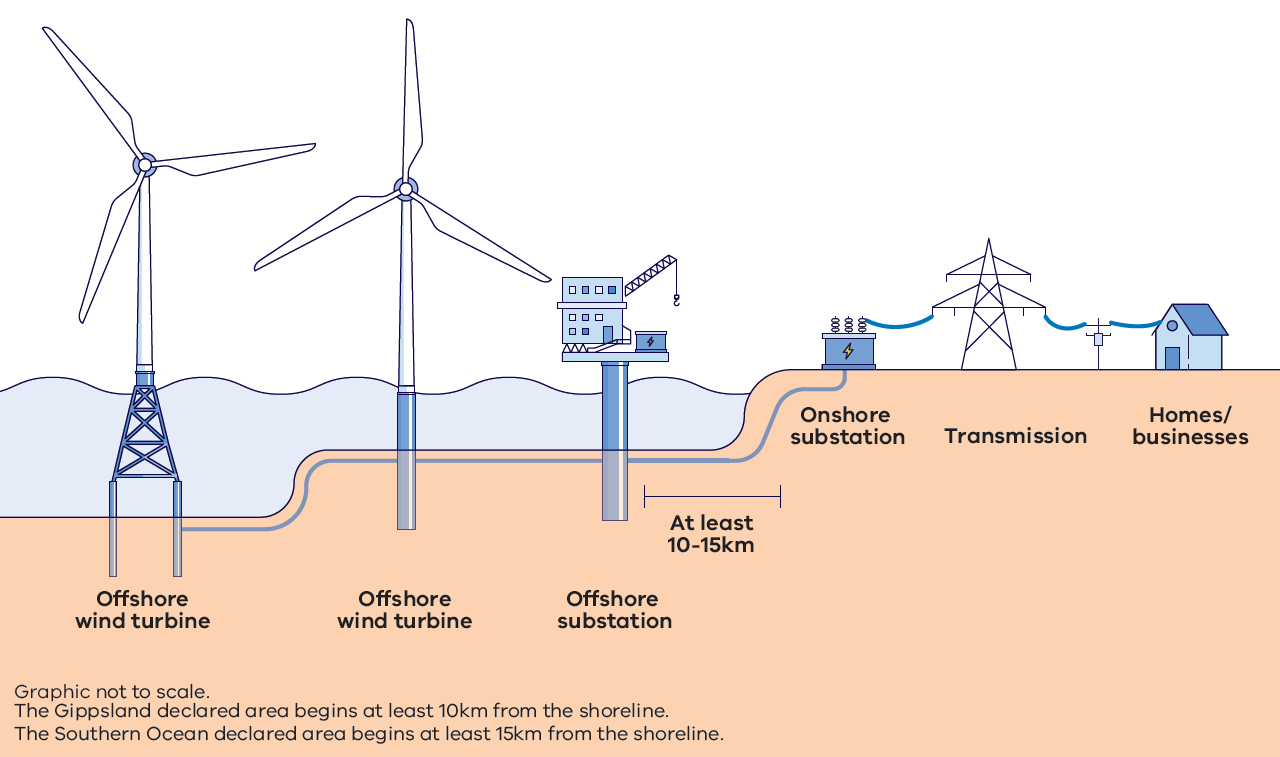
Undersea cables transport the electricity to an offshore substation, where a transformer steps up the voltage. High voltage undersea cables then transmit the electricity to an onshore substation where it is further processed so it can be connected into existing transmission infrastructure to power homes, industry and businesses.
Offshore wind turbines generate clean electricity from strong winds out to sea. They are larger and more powerful than onshore wind turbines. Offshore turbine blades can be more than 100 metres long and are supported by structures more than 200 metres tall.
Foundations secure turbines to the ocean floor. Foundations can be fixed-bottom (anchored to the seabed in waters up to 60 metres deep) or floating (moored to the seabed by cables in waters deeper than 60 metres).
Cables transport the electricity from the turbines to substations.
Offshore substations capture the power generated by the turbines and prepare it for transmission to shore.
Onshore substations connect the electricity supplied by offshore wind farms to the onshore grid. Substations can vary in type, size and layout. Typically, they will occupy six to nine acres and consist of two to eight buildings that are up to about 15 metres high. The site includes roads, fences and landscaping, and may also include an open yard.
Control systems manage the operation of the turbines, monitor the performance of the substructures and foundations, and ensure the safety of the entire system. These systems use advanced sensors and communication technologies to collect and analyse data in real time.
Offshore wind turbines and foundations
Offshore wind turbines are much larger than wind turbines on land and are secured to the seafloor using either fixed-bottom or floating foundations.
Turbines
An offshore wind farm is made up of many turbines spread across the project area. The number and size of these turbines determine how much electricity a farm can produce.
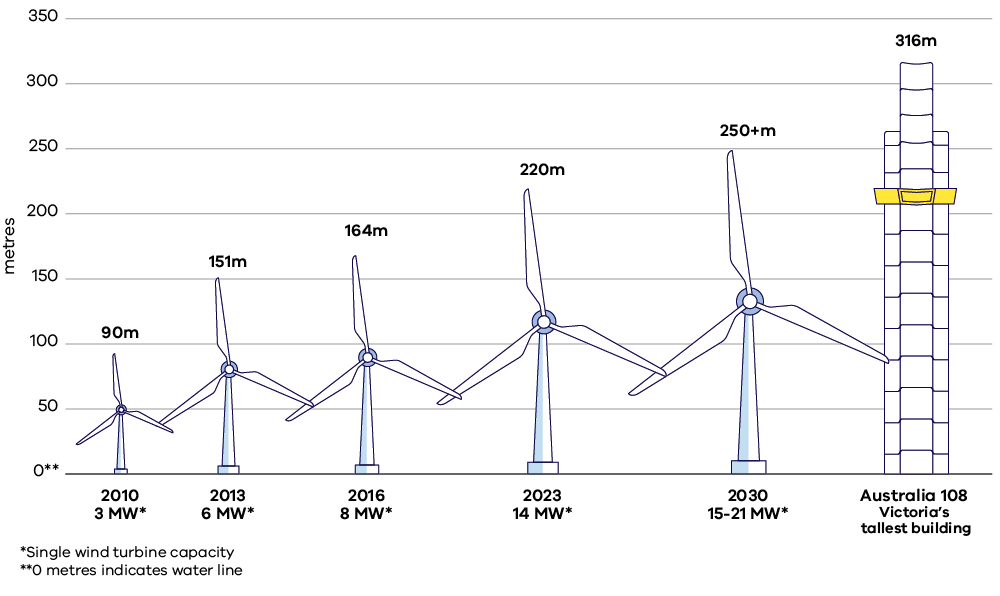
Offshore wind turbine technology is constantly evolving. The latest technology, a 15-megawatt (MW) turbine, can reach up to 270 metres tall, with blades that are up to 115 metres long. Victoria's tallest building, Australia 108, is 316 metres tall.
Wind turbine size for planned offshore wind projects in Victoria hasn’t been decided yet.
One 15 MW turbine can produce enough electricity in a year to power approximately 20,000 households and save around 38,000 tonnes of carbon dioxide emissions.
An offshore wind farm that uses 15 MW turbines and has a generation capacity of 2 gigawatts (GW) may need just over 130 turbines and will have the capacity to generate enough electricity to power 1.5 million homes per year.
Foundations
Foundations secure turbines to the ocean floor and can be fixed-bottom (anchored to the seabed in waters up to 60 metres deep) or floating (moored to the seabed by cables in waters deeper than 60 metres).
Fixed-bottom foundations are used for offshore wind turbines in waters up to 60 metres deep. They are secured directly to the seafloor. The type of fixed-bottom foundation used, such as monopile and jacket, will depend on different seabed and ocean conditions. Fixed-bottom foundations are the most common foundation used for offshore wind globally.
Floating foundations are used for offshore wind turbines in waters deeper than 60 metres. They are anchored to the seafloor with long cables called 'mooring lines'. The type of floating foundation used will depend on location, seabed conditions, marine life and uses for the area, such as fishing. Floating foundations are a new technology and not as common in offshore wind projects globally.

Offshore substations and cables
Offshore substations and cables play important roles in the offshore wind generation process.
Offshore substations capture the electricity generated by offshore wind turbines and prepare it for transmission to the onshore substation; cables help transport electricity from turbines to offshore substation and from offshore substation to onshore substation.
Offshore substations
An offshore substation converts the electricity generated by the turbines to a higher voltage so it can be efficiently transmitted to shore.
The number of offshore substations required for an offshore wind farm depends on the size and layout of the project, distance of the wind turbines from shore, and existing electrical grid infrastructure.
The size of an offshore substation also varies. It usually consists of a platform with one or more decks, can be up to 40 m in height, around 70 m long and 50 m wide, and is fixed to the ocean floor by either jacket or monopile foundations.
Cables
Electricity generated by offshore wind turbines is carried to the offshore substation by array cables. These cables are buried between 0.5 m to 2 m beneath the seafloor.
Export cables transfer the electricity from the offshore substation to an onshore substation where it is converted to the correct voltage and fed into the grid. Export cables are buried 1-2 m beneath the seafloor.
In cases where it is not possible to bury cables due to seabed constraints, they are covered by protective materials such as rock or concrete.
Offshore wind around the world
Many countries have established offshore wind farms, and many more are using the technology as part of their renewable energy transition.
- Denmark has been a leader in offshore wind energy since the 1990s, when it built the world's first offshore wind farm in Vindeby.
- The United Kingdom has been a pioneer in offshore wind energy since the early 2000s. The country has several large offshore wind farms, including the 1.4 GW Hornsea 2, which is the world’s largest offshore wind farm.
- China leads the world in offshore wind generation capacity, with more than 31 GW installed.
- Visit this Global Wind Power Tracker map to learn more about offshore wind projects around the world.
There is strong global support and coordination around offshore wind – including the Global Offshore Wind Alliance (GOWA), which was founded to create a driving force for the uptake of offshore wind. Victoria became a sub-national member of GOWA in August 2023.
Visit our Offshore wind directory for more information about offshore wind around the world and other important offshore wind resources.
Stay updated on offshore wind energy
Get the latest news and updates on offshore wind energy developments in Gippsland and the Southern Ocean.
Page last updated: 26/11/25