
On this page:
Fire hazards in ceiling spaces
There are several fire hazards that are present when installing ceiling insulation. These hazards can pose a risk of fire during installation, as well as the risk of fire post-installation as the result of non-compliant installations.
This guidance sheet covers some of the key fire risks associated with insulation being installed in ceiling spaces.
During installation
- Smoking or vaping in a ceiling space
- Use of lithium-ion batteries
Post installation
- Halogen downlights – these lights emit significant amounts of heat, meaning it is necessary to keep sufficient space around them to allow heat to dissipate. If encapsulated or covered by insulation, this heat cannot dissipate, resulting in fires.
- During the Home Insulation Program (2009-10), 197 house fires started as the result of poorly installed insulation, including insulation installed which encapsulated halogen downlights. In addition, some early forms of LED lighting also do not have sufficient heat dissipation to be covered by insulation.
Due to the significant fire risk, the only types of downlights that can be covered in the VEU Ceiling Insulation activity are IC / IC-4 luminaires as defined by AS/NZS 60598.2.2:2016.
This sheet covers:
- the risks of lithium-ion batteries
- the risks of smoking and vaping in ceiling spaces
- how to identify non-compliant downlights that must be removed before insulation is installed.
Risk: Lithium-ion batteries
While unlikely, there is a risk that lithium-ion battery powered equipment may catch fire in a ceiling space.
Ceiling spaces are restricted spaces. It is therefore important that when not in use, lithium-ion battery powered equipment is not blocking the exit from the ceiling space.
| Risk | Information |
|---|---|
| The risk | When overheated, lithium-ion batteries can enter thermal runaway and catch fire. These fires can be difficult to extinguish and may reignite. Smoke and gases released during a battery fire can be toxic and should not be inhaled. |
| Assessing the risk |
Battery fires can occur when:
The risk of fires is increased when the battery-operated equipment is larger, which can prevent it from being put out more easily. The risks when working in ceiling spaces are heightened due to their confined nature and lack of exits. |
| Methods to reduce risk |
When working in a ceiling space, the principal method to reduce this risk is to ensure that lithium-ion battery powered equipment does not block the exit from the ceiling space. This will prevent you from becoming trapped by a potential fire. In addition, you can help prevent lithium-ion battery fires by:
|
For further information about the dangers of lithium-ion batteries and how to mitigate this issue, please see WorkSafe Victoria’s advice.
Risk: Smoking and vaping
Smoking and vaping is prohibited while working in enclosed spaces such as ceiling spaces.
Smoking or vaping in ceiling spaces creates several risks:
- Ceiling spaces often have limited ventilation, so smoking or vaping can decrease air quality and increase temperatures.
- Vapes can, in rare circumstances, catch fire or experience battery failure. As most vapes contain lithium-ion batteries, any resulting fire can be difficult to extinguish and may rapidly increase in intensity, particularly within an enclosed space such as a ceiling cavity.
- Smoking or vaping could ignite combustible materials. Fires in ceiling spaces can spread rapidly and may be more difficult to control or escape from.
In addition, there are several long-term health impacts from both smoking and vaping.
In Victoria, smoking and vaping is banned in enclosed spaces. An enclosed space is defined as an area, room or premises that is substantially enclosed by a roof and walls, regardless of whether the roof or walls or any part of them are permanent, temporary, open, or closed.
For more information see the Department of Health guidance on Enclosed workplaces: smoke-free and vape-free.
Risk: Damaged wiring
Damaged wiring is often found in ceiling spaces within residential properties and can result from a range of factors, including deterioration over time, poor installation, environmental factors and physical damage caused by vermin.
Damaged wiring presents an increased level of risk and may lead to the following hazards.
- Electric shock or electrocution: Damaged wiring may expose live conductors, creating a risk of electric shock, severe burns, cardiac arrest or even death. Electricity may also energise conductive building elements, such as steel framing, battens or other metal components, causing them to become live. This risk is heightened in ceiling spaces due to restricted movement, limited visibility and the increased likelihood of accidental contact with electrical infrastructure or energised metal surfaces.
- Fire risk: Damaged wiring may arc, spark or overheat. The presence of dust, insulation or debris withing the ceiling space can significantly increase the fire load and likelihood of ignition.
In Victoria, there is an average of 3,000 house fires per year and reports suggest that one quarter of residential fires is the result of damaged wiring.
Identifying compliant downlights that can be covered by insulation
Note: As part of the VEU Ceiling Insulation activity, the only downlights permitted to be covered by insulation are IC/IC-4 luminaires – as defined by AS/NZS 60498.2.2:2016.
Any light fittings that are not classified as IC or IC-4 must not be covered by insulation. Where removal or modification of a light fitting is required to facilitate the installation of insulation, this must be assessed and completed in accordance with electrical safety requirements and, where applicable, by a licensed electrician.
This section will help you identify downlights (also called luminaires) that are permitted to be covered or encapsulated in the program.
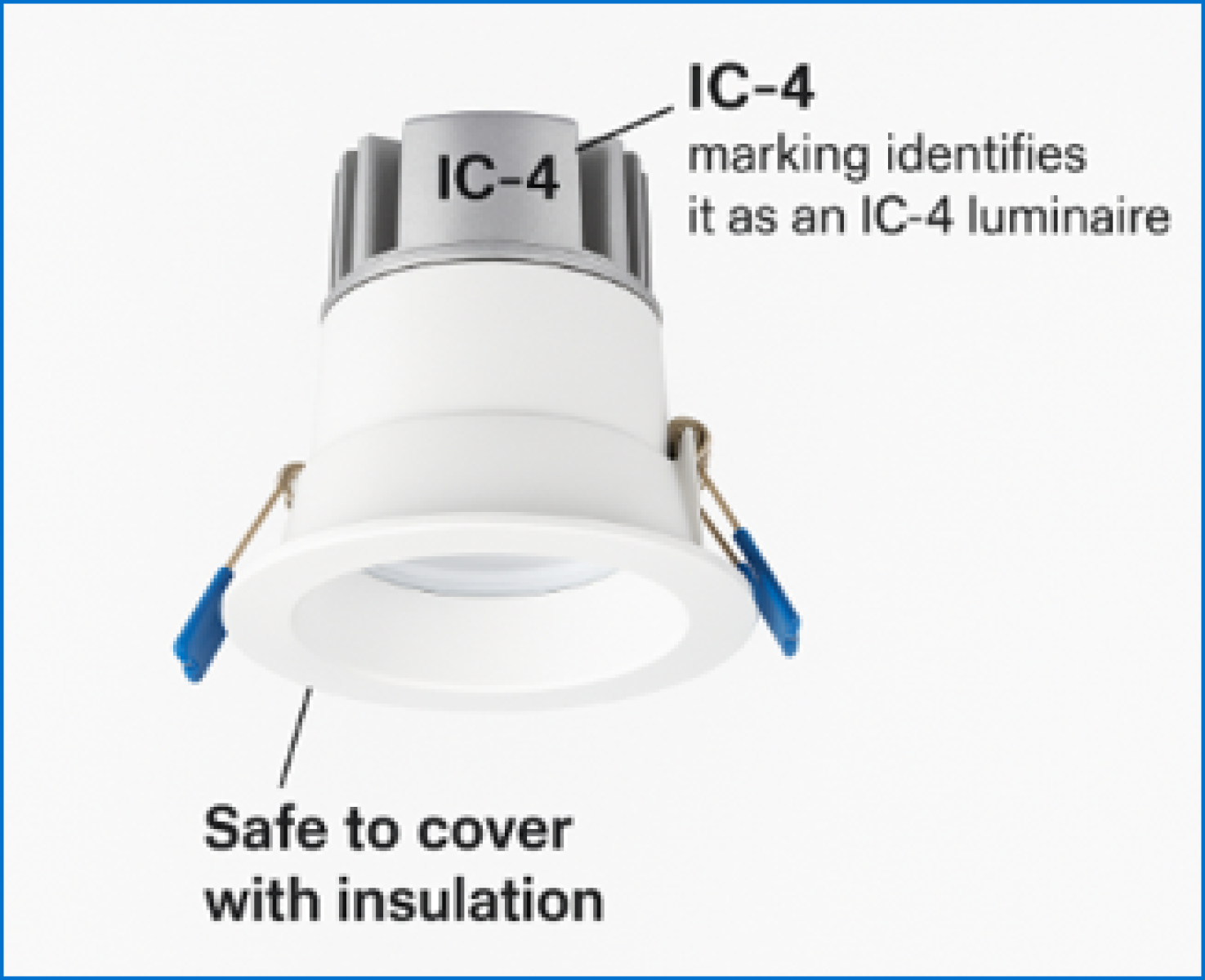
IC-4 Luminaires (Downlights): PERMITTED
Downlights that are permitted to be covered with insulation will be marked “IC-4”, shown in the following images. IC-4 luminaires are designed in a way that prevents them from heating up excessively, meaning it is safe for them to be covered with insulation.
Other Downlights: NOT PERMITTED
Downlights without an IC-4 marking are not safe to cover with insulation. These downlights create significant amounts of heat and if left covered, can result in fires.
Some of the common types of downlights that may be present in residential homes (and need to be replaced before insulation is installed) include the following:
- Downlights labelled CA90. These downlights require a clearance gap above them to allow heat to dissipate, meaning they cannot be covered by insulation.
- Non-IC downlights. These are not safe to be near insulation due to high risk of causing fire. These downlights should not be installed in residential homes.
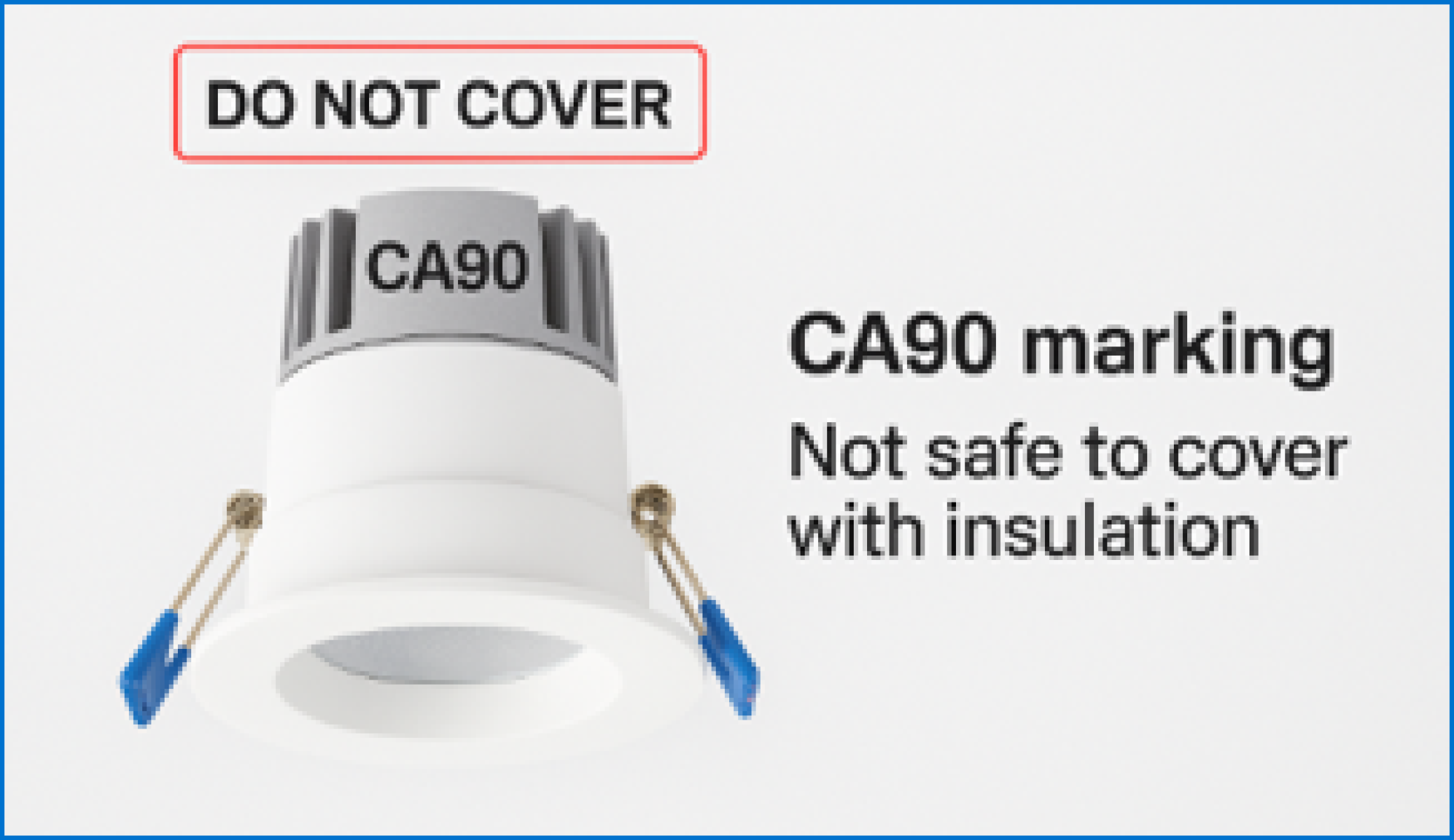
Covering these types of downlights with insulation will pose a significant fire risk. It is critical that you do not cover these downlights with insulation.
If you encounter these types of downlights when installing insulation, do not cover with insulation until the downlights have been replaced.
Continue through the guidance series
Page last updated: 01/10/26