
On this page:
Planning a safe approach to rooftop insulation installation
In many rooftop insulation installation jobs, access to the ceiling cavity can only be achieved by entering through a temporary opening in the roof.
Working on roofs raises a number of different fall risks, including:
- falling from the roof
- falling through the roof
- falling through an opening in the roof
- falling while accessing a roof.
Note: A separate technical guidance sheet (2.5 – Falls through ceiling spaces) covers falls through the ceiling cavity, and appropriate risk mitigation measures such as the use of kneeboards.
Follow this 4-step risk management process to ensure hazards are identified, risks are assessed and controlled, and that employers fulfil their duty to monitor, review and revise controls when required:
Figure 1: The 4-step risk management process
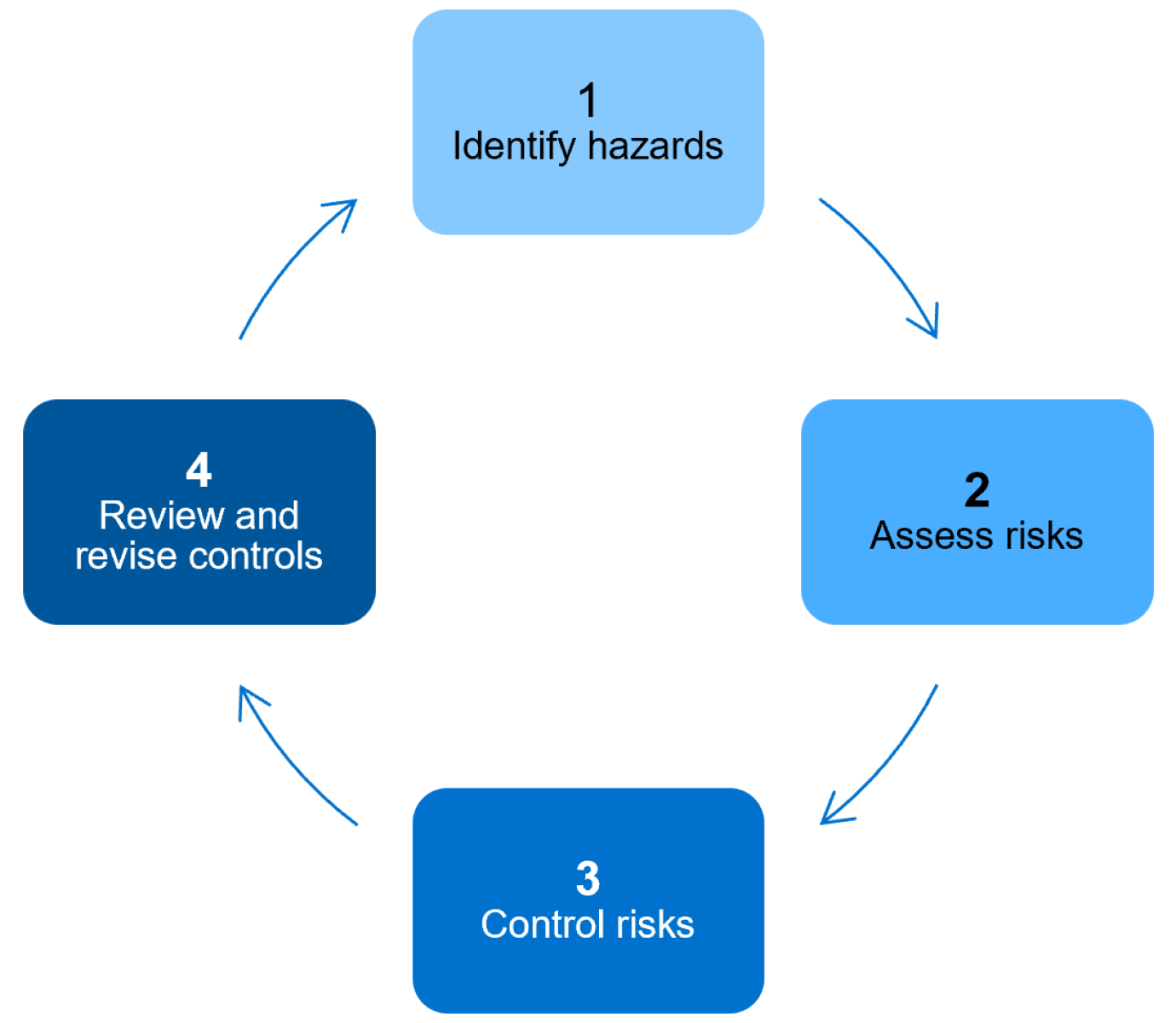
Step 1: Identify hazards – determine if there is a fall risk
For rooftop insulation installations where roof access is necessary, the first step in the risk management process is to identify hazards associated with working at height.
This may include considering the location of skylights, fragile roof sections, voids and penetrations within the work area.
Identification and assessment of these hazards should take into account the roof material and construction method to ensure the work area is capable of supporting workers, materials, tools and equipment.
It is important to determine:
- the presence and condition of skylights, plastic roof sheeting and other brittle roof sheeting such as asbestos cement sheeting, rooted timbers, corroded metal, glass, slate, etc.
- if a proprietary guardrail system can be installed to the edges of the skylights, polycarbonate sheets or fragile roof areas to prevent access to those areas.
Step 2: Assess risks – before working on a roof
Falling through a roof or skylight can be fatal or result in life-changing injuries. Employers have a duty to assess and control risks associated with a fall of greater than 2 metres and document these in a safe work method statement (SWMS) due to the classification of such work as high-risk construction work (HRCW).
Employees undertaking rooftop insulation installations must be informed of, and consulted on the risks and control measures, including those contained within a SWMS. Ensure the SWMS is prepared before the work commences and ensure that the work is performed in accordance with the SWMS.
See the WorkSafe website for more information on when and how to complete a SWMS for construction activities: Safe Work Method Statements (SWMS).
When assessing the risk of falling through a roof while undertaking rooftop insulation installations, consider the following:
- identify any obvious holes or weaknesses on the roof
- are there any skylights or other openings in the worksite vicinity?
- is there any damage to the roof or work surface such as water or fire damage?
- are there any areas of structural instability?
Stay vigilant - keep a look out for all risks throughout the duration of the work and take appropriate precautions when working in an unfamiliar work area.
Step 3: Control risks – how can you manage the risk of falling through a roof?
Skylights, penetrations and fragile roof sheeting should be classified as non-trafficable areas – that is, areas that should not be walked on. Reasonably practicable control measures must be put in place to prevent insulation workers from stepping or falling onto non-trafficable surfaces.
When the risk of a fall greater than 2 metres exists these control measures must, so far as is reasonably practicable follow the hierarchy of controls as set out in Regulation 44 of the Occupational Health and Safety Regulations 2017 (OHS Regulations).
Remember – the highest level of control is elimination of any risk associated with a fall at a workplace, for example, can some tasks be completed at ground level prior to being transferred to a roof?
Control measures could include:
- Avoid accessing non-trafficable areas. When possible, work from a solid construction or elevating work platform to avoid standing on or near brittle and dangerous areas.
- Install physical barriers around the non-trafficable areas, such as guard rails or suitably rated covers that are secured and labelled with warning signs.
- Use temporary walkways or crawling boards of appropriate size and strength.
- Install safety mesh secured under fragile roofing or skylights (see AS/ NZS 4389:2015 Roof safety mesh).
- As a last resort, install a fall arrest system which has adequately installed and maintained anchor points, along with ensuring employees are trained in its correct use.
Step 4: Review and revise controls – during installation
Implementing control measures for falls during rooftop insulation installations is not the end of the risk management process. An employer has a duty to review and, if necessary, revise control measures:
- before making alterations to any plant or system of work that is likely to result in a fall
- after a notifiable incident has occurred
- if the control measures are inadequate
- at the request of a Health and Safety Representative.
Some examples of control measures to constantly review and revise include:
- locating any skylights, roof hatches, vents, or other openings on the roof, and addressing the potential fall risks
- ensuring roof material conditions are monitored for weakness or deterioration
- training on how to safely navigate trip hazards while working on a roof
- instruction on the correct use of equipment and materials that are going to be used on the roof
- inspection of edge protection and fall protection systems (see Technical Solution Sheet 1.2: Edge protection - Working at height)
Finally, always make sure your employees are aware of all hazards on a roof where they are working and that adequate steps are taken to control risks.
Your actions shouldn't stop at Step 4. You should repeat this process often to make sure your management of risk is working.
Continue through the guidance series
Page last updated: 01/10/26