
On this page:
Using ladders during rooftop insulation installations
Employers have a duty to provide and maintain, so far as is reasonably practicable, a working environment that is safe and without risks to physical harm and health. The use of portable ladders presents a risk of fatal or serious injury for anyone needing to gain access to a roof or conduct light tasks.
For rooftop insulation installers, the risks may be increased due to the need to regularly move between the ground and roof.
In the hierarchy of control, ladders must only be used to reduce the risk of a fall of more than 2 metres after consideration of elimination, passive fall prevention, work positioning systems and fall arrest systems are not reasonably practicable.
If a ladder is to be used to reduce the risk of a fall of more than 2 metres, it must be used in accordance with regulation 45 of the Occupational Health and Safety Regulations 2017 (OHS Regulations) by ensuring that the ladder is fit for purpose, appropriate for the duration of the task and is correctly set up.
For more information on the hierarchy of controls associated with the risk of a fall of more than 2 metres, see regulations 44 and 45 of the OHS Regulations.
Ladders should only be used for access or light tasks that don't take too long to complete. They should not be used where large, heavy, or bulky items need to be installed or removed, for example, lifting rolls of insulation onto a roof or using tools that require 2 handed dynamic operation such as pry bars or rotary hammer drills.
Follow this 4-step risk management process to ensure hazards are identified, risks are assessed and controlled, and that employers fulfil their duty to monitor, review and revise controls when required:
Figure 1: The 4-step risk management process
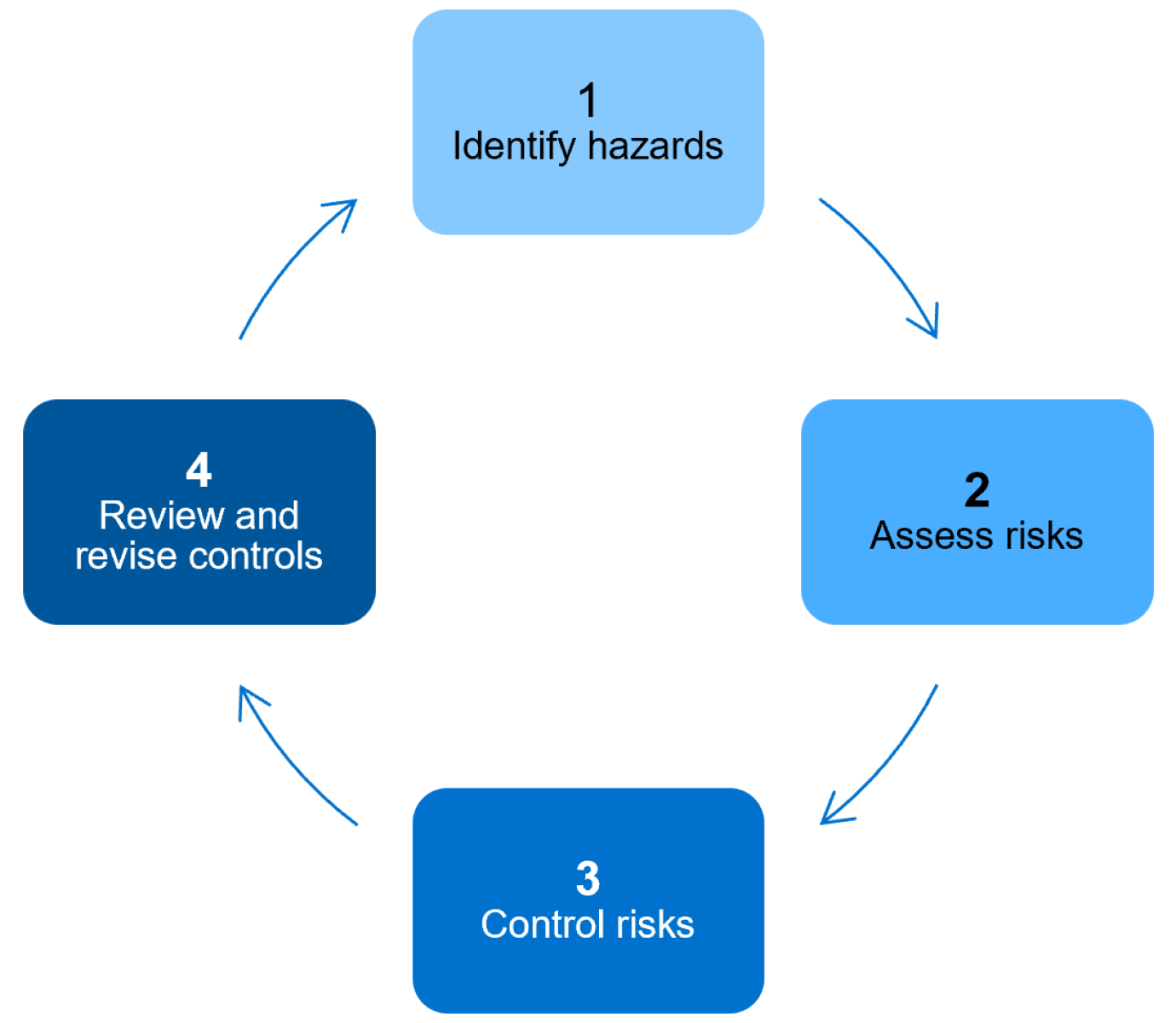
Step 1: Identify hazards – before using a portable ladder
The starting point to managing risk is identifying the hazards associated with utilising ladders during rooftop insulation installations. It is important to understand where hazards exist and what strategies can be implemented to reduce the risk of injury.
To keep employees safe, identify hazards prior to using ladders including:
- suitability of ground conditions to use a ladder
- options to secure the ladder at top and bottom
- access of unauthorised persons, pets or vehicles from doorways, driveways and garages
- overhead conductors in the vicinity of the work area
- penetrations or live edges in the vicinity of the work area
- safe working loads of ladders to be observed
- wear or chemical contamination on the ladder that may affect functionality and safe use
- employees who require supervision
- requirement for exclusion zones
- suitability of the ladder for electrical work.
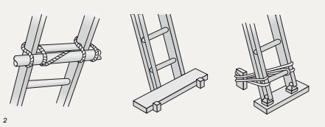
Figure 2: Some effective ways of securing a ladder
Step 2: Assess risks – plan your use of ladders
Assess the risks to health and safety arising from the identified hazards. If a task involving a fall hazard has been identified, the risk of a fall can be assessed by determining:
- the likelihood of a fall occurring
- the potential distance a person could fall
- the extent of harm that a person could experience in the event of a fall
- the potential for people other than employees to be harmed, for example, pedestrians or homeowners.
Ensure relevant information is documented in a safe work method statement (SWMS) when required. Employers and self-employed persons must provide their workers with a SWMS before undertaking high-risk construction work (HRCW).
HRCW includes work where there is a risk of a person falling more than 2 metres. Employees undertaking HRCW must be informed and consulted in determining risk controls during the SWMS preparation process. Ensure the SWMS is prepared before the work commences and ensure that the work is performed in accordance with the SWMS.
Where risk of a fall from a height greater than 2 metres exists, employers have a duty to document an emergency procedure to rescue and provide first aid to a worker immediately after the event of a fall as per regulation 49 of the OHS Regulations.
See the WorkSafe website for more information on when and how to complete a SWMS for construction activities: Safe Work Method Statements (SWMS).
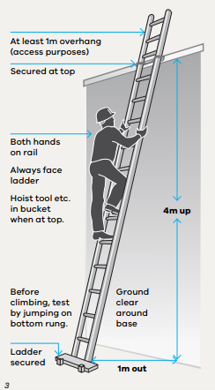
Figure 3: Acceptable ladder use
Step 3: Control risks – how can you control the risk of falling from a ladder?
Control measures need to be in place to keep employees safe when using ladders during installation of insulation systems.
Remember that the requirement for employers to consult with employees and independent contractors produces better outcomes due to their direct participation in identification, evaluation and adoption of new risk control measures and concepts.
Direct participation also gives a sense of ownership that translates to improved uptake of control measures when implemented.
Regulation 44 of the OHS Regulations outlines the hierarchy for controlling risks associated with falls greater than 2 metres:
- where reasonably practicable, eliminate the risk of a fall, for example by doing as much of the preparation work as possible on the ground
- to minimise risk, so far as is reasonably practicable, by using passive fall prevention devices, work positioning systems, or by using fall arrest systems.
A ladder must only be used if higher order control measures within the hierarchy of control in regulation 44 of the OHS Regulations are not reasonably practicable. In this instance, a ladder must be fit for purpose, appropriate for the duration of task and set up correctly.
Fall prevention systems
The risk of falling from a ladder during a rooftop insulation installation can be greatly minimised by having simple fall prevention controls in place. For example:
- the ladder should be checked for damage to ensure it is in a serviceable condition before use
- the ladder should be an industrial type, comply with AS 1892.1:2018 Portable ladders, Part 1: Performance and geometric requirements and safe working loads observed
- the ladder should be secured at top and bottom to prevent it slipping sideways or outwards
- the ladder stiles should extend one metre above the landing surface
- ensure the 4:1 ratio is employed, one metre out for every four metres of height
- face the ladder at all times when ascending or descending
- maintain three points of contact with the ladder at all times whilst ascending or descending
- carry tools on a tool belt or in a backpack
- never overstretch while on a ladder, keep the body centred within stiles
- do not climb higher than the third step from the top of a straight ladder and never straddle the top of an A-frame ladder.
Remember: Doing nothing is not an option.
Step 4: Review and revise controls
Control measures are more effective where there is regular review of work procedures to make sure they are working as planned. An employer must review and, if needed revise control measures:
- before changes are made to equipment of systems of work that could result in a fall
- if a notifiable incident occurs that involves a fall or a risk associated with a fall
- if for any reason, the risk control measures fail to adequately control the risk
- a Health and Safety Representative requests a review and/or revision of a control.
Your actions shouldn't stop at Step 4. You should repeat this process often to make sure your management of risk is working.
Continue through the guidance series
Page last updated: 01/10/26