
On this page:

What is edge protection?
Edge protection is a passive fall prevention system used to protect workers when working at heights. It acts as a physical and visible barrier around the perimeter of a work area to help prevent employees, tools, and equipment from falling.
Edge protection comes in many different forms, including scaffolds or guard railing. It is important to use an edge protection system that is suitable for the worksite and the task being undertaken.
Where the risk of a fall greater than two metres cannot be eliminated, it must be reduced so far as is reasonably practicable by using a passive fall prevention device.
Where passive fall prevention will be used, proprietary edge protection systems should be considered because:
- they are commercial systems that have been designed, manufactured and tested in accordance with AS/NZS 4994.1 Temporary edge Protection, Part 1: General Requirements
- the manufacturer provides instructions and recommendations for installation and dismantling in accordance with AS/NZS 4994.2 Temporary edge Protection, Part 2: Roof Edge Protection – Installation and dismantling.
- there are numerous proprietary temporary edge protection systems available that can be used and adapted for a wide range of roof types.
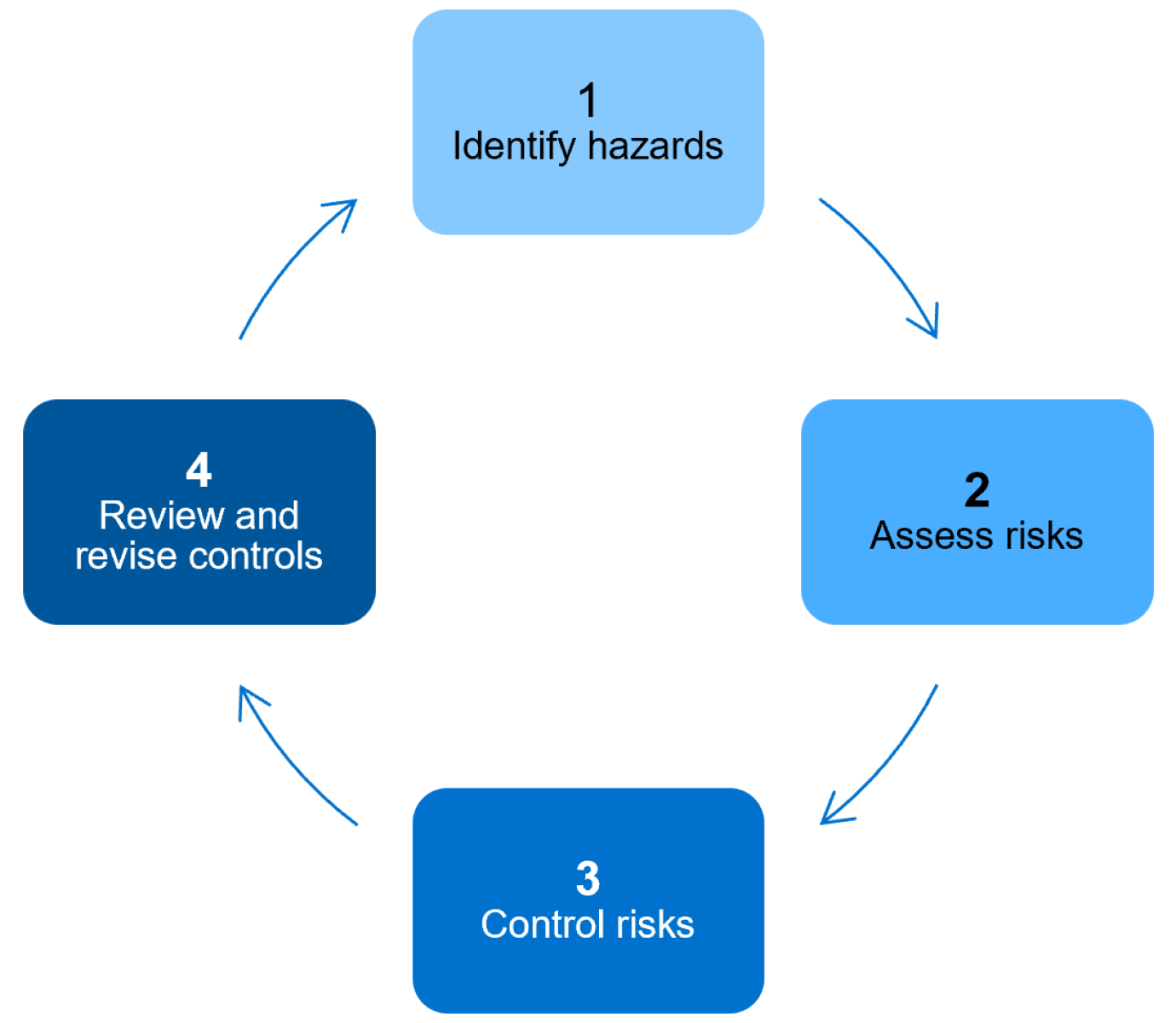
Follow this four-step risk management process to ensure hazards are identified, risks are assessed and controlled, and that employers fulfil their duty to monitor, review and revise controls when required:
Figure 1: The four-step risk management process
Step 1: Identify hazards – before installing edge protection
Falls while working from height remains the most serious risk associated with rooftop insulation installations. If you cannot eliminate the risks of working above two metres, edge protection is the best control measure to protect insulation employees undertaking residential retrofit rooftop insulation installations.
To keep employees safe during the installation and dismantling of edge protection, identify hazards including:
- site-specific issues such as the homeowner, their pets, and the public
- building entrances, garages and driveways
- location of skylights, voids and penetrations
- ground conditions and the need for any exclusion zones
- location and voltage of any overhead conductors
- weather related events
- buildings with unusual plan profiles or roof construction
- potential for dropped objects or tools to injure persons at ground level.
Ensure relevant information is included in a safe work method statement (SWMS) when required (including where there is a risk of a person falling more than two metres), and that employees adhere to the control measures stipulated by the agreed systems of work.
Employers must so far as reasonably practicable consult with their employees (including any HSRs and independent contractors) when identifying or assessing hazards or risks to health and safety.
See the WorkSafe website for more information on when and how to complete a SWMS for construction activities.
Step 2: Assess risks – plan your installation of edge protection
Before installing or dismantling edge protection systems, develop a plan for when you will need edge protection, how it will be installed and how to manage the risks during installation and while tasks are being undertaken. Your plan must include an emergency response procedure that, so far as is reasonably practicable, enables the rescue and provision of first aid to an employee, in the event of a fall.
During the planning phase make sure:
- the worksite can accommodate the safe installation and dismantling of the system
- the method and sequence of installation has been developed by competent persons in consultation with employees
- all components of the system are well maintained and suitable for use. Do not use any component that shows signs of damage
- the system is compatible with the roof supporting structure and is able to maintain its integrity
- safe access and egress from the roof are guaranteed for workers without needing to step over or through the edge protection system.
Employers and self-employed persons must provide their workers with a safe work method statement (SWMS) before undertaking high-risk construction work (HRCW). HRCW includes work where there is a risk of a person falling more than 2 metres. Employees undertaking HRCW must be informed and consulted in determining risk controls during the SWMS preparation process.
Note: If in doubt, seek expert advice where the edge protection system is to be erected in an unusual, or unfamiliar work area.
Step 3: Control risks – safe installation of edge protection
To safely install edge protection, the system needs to be erected and dismantled by competent persons who have the requisite knowledge, skills, training and equipment to install and dismantle the system in accordance with the manufacturer's recommendations and the agreed system of work.
Make sure the edge protection system:
- is high enough to prevent workers from falling over the top rail (minimum 900 mm above the working surface)
- includes top, mid and bottom rails with gaps not exceeding 450 mm
- is installed as close to the open edge as is reasonable with no gap between the roof edge and a guardrail located outside the roof line to exceed 100 mm
- has a clear distance between the roof cladding and the bottom rail of not less than 150 mm and not greater than 275 mm
- includes toeboards or infill panels where the pitch of the roof exceeds 26 degrees or ground conditions warrant protection
- is strong enough to withstand the force and weight of employees, their tools, and materials likely to cause loading to the system.
Where it is not reasonably practicable to utilise passive fall prevention to control the risk of a fall greater than two metres, regulation 44 of the Occupational Health and Safety Regulations 2017 (OHS Regulations) stipulates the hierarchy of control measures that employers must follow in order to reduce, so far as is reasonably practicable, the risk associated with falls greater than 2 metres.
Step 4: Review and revise controls during installation
Edge protection should be inspected to ensure the installation complies with AS/NZS 4994.2:2009 Temporary edge Protection, Part 2: Roof Edge Protection – Installation and dismantling and the manufacturers' instructions prior to any employee accessing the roof. Under regulation 48 of the OHS Regulations you must also undertake a review in the following circumstances:
- before any change is made to plant or systems of work that is likely to result in a fall
- after a notifiable incident occurs that involves a fall or a risk associated with a fall
- if the control measures do not adequately control the risks
- at the request of a health and safety representative.
Periodically inspecting the system is also recommended, especially after unplanned events such as adverse weather or long periods of time without use.
Your actions shouldn’t stop at Step 4. You should repeat this process often to make sure your risk controls are working.
Download a copy of this guidance sheet
Continue through the guidance series
Page last updated: 01/10/26