
On this page:
Risk management process
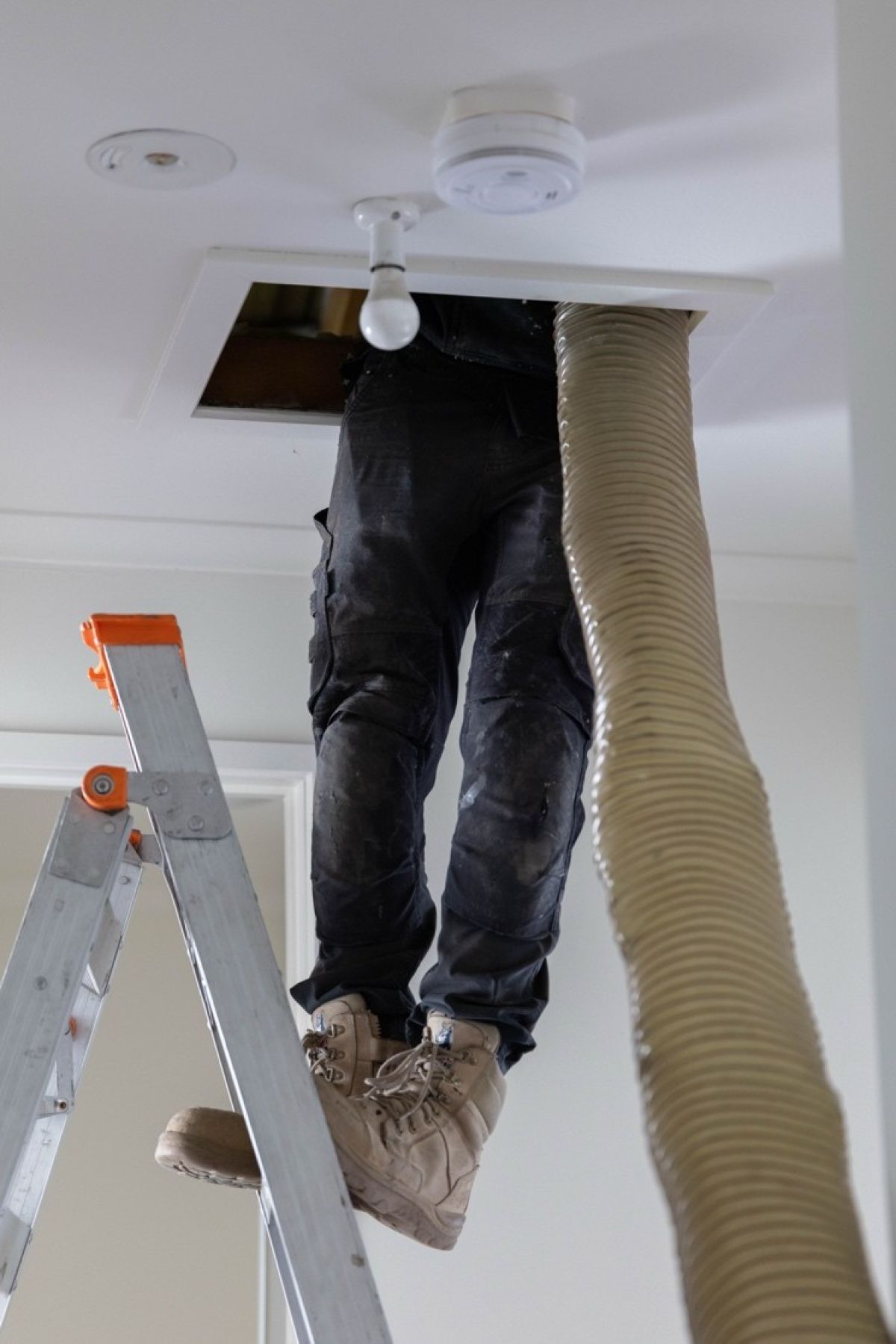
When installing insulation, it’s vital to have a plan in place when working at heights. This is especially important to ensure worker safety when accessing the roof cavity from the roof structure and assessing all risks.
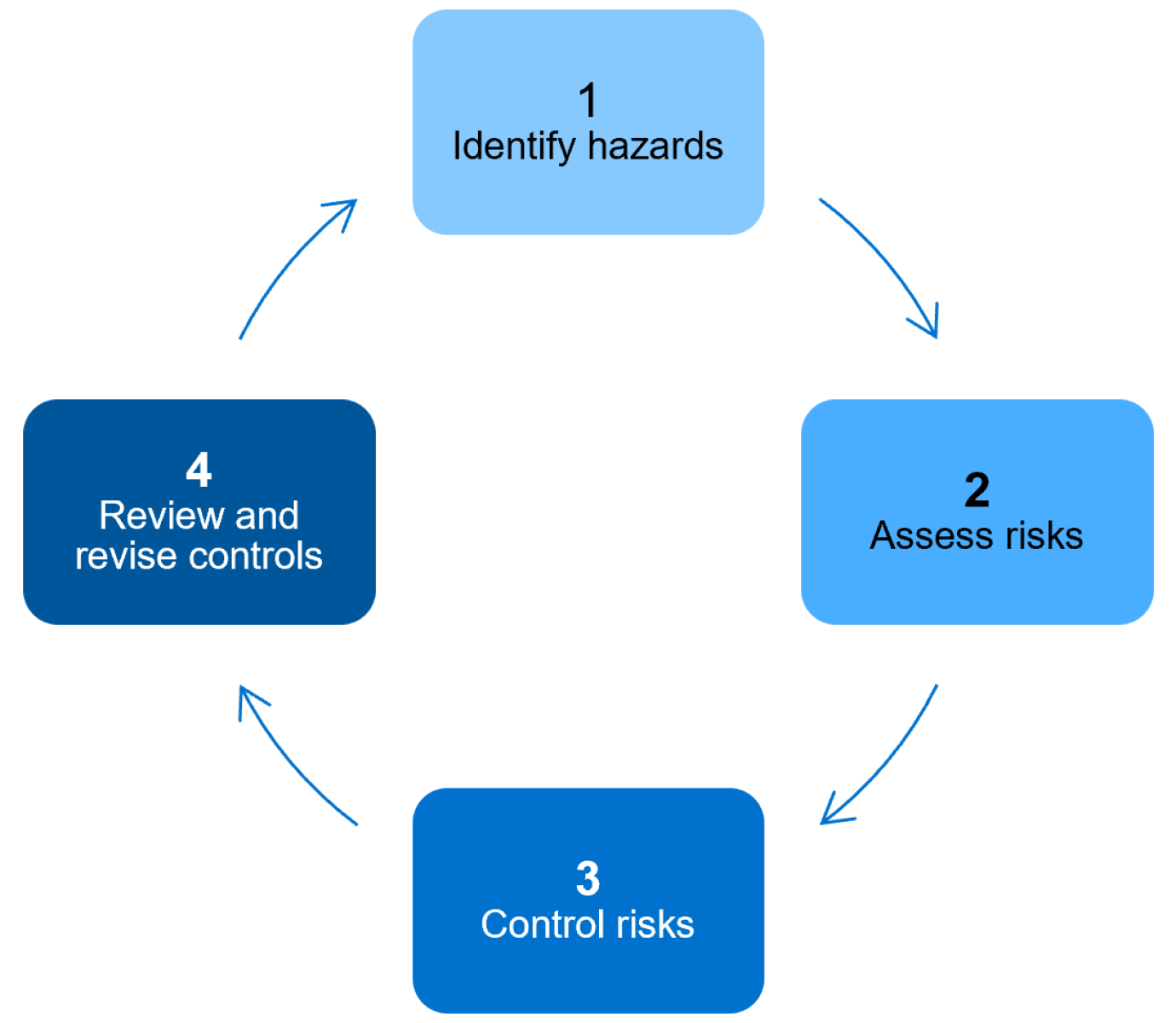
Follow this four-step risk management process to ensure hazards are identified, risks are assessed and controlled, and that employers fulfil their duty to monitor, review and revise controls when required.
Figure 1: The four-step risk management process
Step 1: Identify hazards
The first step in the risk management process is to identify fall hazards. Start by identifying all tasks an employee is required to undertake at a workplace that involves the risk of falling more than two metres while installing and handling insulation including:
- on any plant or structure being constructed, inspected, tested, maintained, repaired, or cleaned
- on a fragile, slippery or potentially unstable surface – for example, cement sheeting roofs, rusty metal roofs, fibreglass sheeting roofs and skylights
- using equipment to gain access to an elevated level or to undertake the task at an elevated level – for example, scaffolds or portable ladders
- on a sloping surface on which it is difficult to maintain balance – for example, on glazed tiles or wet steel roof sheets
- near an unprotected edge – for example, near perimeters without guard railing or incomplete stairwells
- near an unprotected hole, trench, shaft or pit that is of sufficient dimensions to allow a person to fall into the hole, trench, shaft or pit.
- Employers must so far as reasonably practicable consult with their employees (including any HSRs and independent contractors) when identifying or assessing hazards or risks to health and safety.
Step 2: Assess risks
Once the hazards have been identified, it is important to assess the risks they pose and determine appropriate control measures. This involves looking at how the hazards might cause harm. The risk of a fall while performing insulation installations can be assessed by determining:
- the likelihood of a fall occurring
- the potential distance a person or an object could fall
- the extent of harm that a person could receive in the event of a fall
- the potential for people other than workers to be harmed, for example, pedestrians or homeowners.
Employers and self-employed persons must provide their workers with a safe work method statement (SWMS) before undertaking high-risk construction work (HRCW). HRCW includes work where there is a risk of a person falling more than 2 metres. A SWMS is a safety planning tool that identifies the hazards and risks and documents the control measures necessary to manage those risks.
The SWMS needs to describe to employees in clear terms how risks from the work will be effectively controlled to enable the work to be done safely. Employees undertaking HRCW must be informed and consulted in determining risk controls during the SWMS preparation process.
Where risk of a fall from a height greater than two metres exists, employers have a duty to document an emergency procedure to rescue and provide first aid to a worker immediately after the event of a fall as per regulation 49 of the OHS Regulations.
See the WorkSafe website for more information on when and how to complete a SWMS for construction activities.
Step 3: Control risks
In line with the duty to provide and maintain a workplace that is safe and without risk to health, employers must eliminate risks associated with a fall greater than two metres so far as is reasonably practicable.
Where elimination is not reasonably practicable, reduction of risk is to be achieved by working though the successive stages of the hierarchy of control for the prevention of falls greater than two metres.
Regulation 44 of the Occupational Health and Safety Regulations 2017 (OHS Regulations) outlines the hierarchy for controlling risks of falls greater than two metres.
Some guiding principles are:
- Elimination of the hazard is always the best approach.
- A combination of controls may need to be used to effectively eliminate the risk, or if elimination is not possible, to minimise the risk so far as is reasonably practicable.
- Employers must so far as reasonably practicable consult with their employees (including any HSRs and independent contractors) when making decisions about how to control risks.
Remember: Doing nothing is not an option.
Table 1: Hierarchy of control for the prevention of falls > 2 metres
| Level | Description | Example |
|---|---|---|
| 1 | Eliminate Risk | Eliminate risk of fall by undertaking work at ground level |
| 2 | Use a passive fall prevention device | Use of systems such as edge protection, scaffolding, perimeter screens, elevating work platforms |
| 3 | Use a work positioning system | Use of an industrial rope access system or travel restraint system |
| 4 | Use a fall arrest system | Use of an industrial safety net, catch platforms or safety harness system |
| 5 | Use a fixed or portable ladder, or implement administrative controls | If the above measures are not reasonably practicable for the task, it may be appropriate to use a fixed or portable ladder, provided it is: fit for purpose, appropriate for duration of the task and set up in the correct manner. |
Step 4: Review and revise controls
Once the risk controls are in place it is important to maintain them and regularly check that they are working as planned by continuing to prevent or adequately control the risks associated with falls.
An employer has a duty to review and, if necessary, revise control measures:
- when making alterations to any plant or system of work that is likely to result in a fall
- after an incident has occurred
- if the control measures are inadequate
- at the request of a Health and Safety Representative.
Your review of the control measures should include:
- MONITORING activities and work practices
- frequent inspections of physical controls such as edge protection systems, scaffolding and guardrails to ensure they are properly installed, used, and maintained
- TESTING of equipment
- VISUAL checks to ensure risk controls that rely on human behaviour are being properly applied by employees
- any necessary remedial work to ensure physical controls continue to work effectively.
Your actions shouldn’t stop at Step 4. You should repeat this process often to make sure your risk controls are working.
Download a copy of this guidance sheet
Continue through the guidance series
Page last updated: 01/10/26