
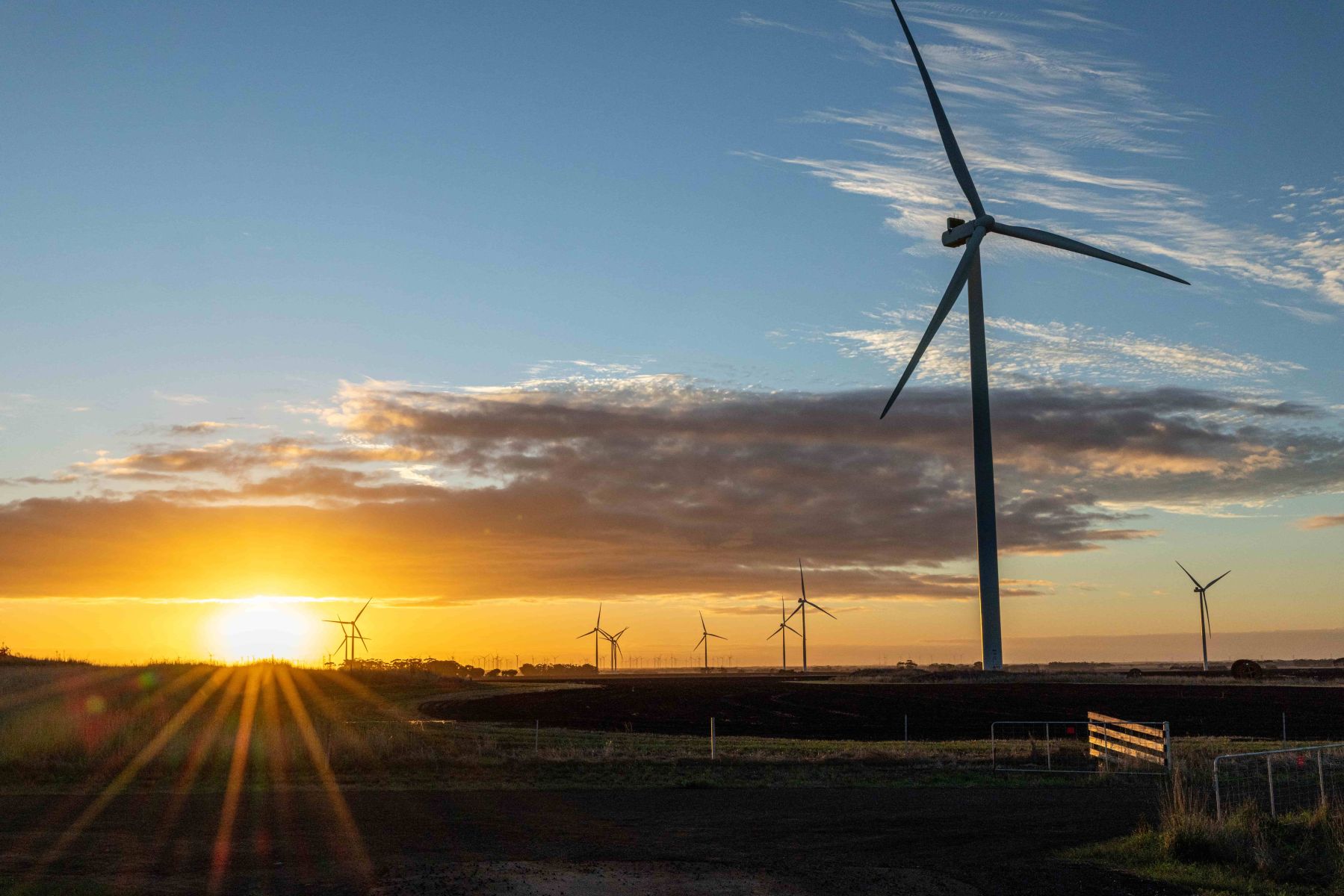
Victoria has exceeded its 2025 renewable energy target, smashing another major milestone in the State’s transition to cleaner, more reliable and affordable energy.
Renewables delivered 44.6% of Victoria’s electricity generation last year - well exceeding the 40% target.
This achievement cements Victoria’s position as the national leader in renewable energy, reflecting the collective effort of individuals, businesses, and government working together to accelerate the transition.
Wind and solar driving renewable growth
Targets have been achieved through ongoing investment in large and small-scale renewable energy infrastructure across the state, with wind and solar generation central to exceeding the 2025 target.
- Wind farms generated approximately 24% of Victoria’s electricity, making wind the single largest contributor to renewable generation.
- Solar energy, including 54 grid-scale solar farms and widespread rooftop solar, supplied around 16% of the state’s power.
- Victoria now has nearly 100 large-scale renewable energy projects operational. This capacity is set to grow, with 5 additional renewable energy projects under construction and a clear vision for Victoria’s offshore wind sector.
Lower prices and strong investment
Victoria is also leading the nation on wholesale electricity prices, driven by growth in renewable energy. This growth has consistently delivered the lowest wholesale electricity prices in Australia. Over the last year, Victoria’s average wholesale price was $78 per megawatt hour, compared to $103 for New South Wales, $96 for Tasmania, $87 for South Australia and $85 for Queensland.
To accelerate further delivery, the Victorian Government’s Development Facilitation Program is fast-tracking priority renewable projects. The program has already unlocked almost $9 billion in investment across 25 projects, supporting more than 3,000 jobs during construction and ongoing operations.
Once completed, these projects will generate enough electricity to power over 700,000 households each year, with battery storage capable of meeting evening peak demand for up to 2 million homes.
Key renewable energy outcomes for Victoria
The renewable energy transition is showing no signs of slowing down, with AEMO’s latest Quarterly Energy Dynamics report highlighting some big wins for Victoria in Q4 2025 as we continue to lead the way in our ambitious push for cleaner, cheaper energy.
Key takeaways for Victoria include:
- Wholesale electricity prices fell across all NEM regions, with an average of $50/MWh and Victoria at $37/MWh, a 44% and 18% reduction from Q4 2024, respectively.
- Distributed PV output increased slightly by 14 MW to an average output of 956 MW, setting a record for Victoria.
- Cumulative CER solar capacity and installations have grown steadily across the NEM since 2020, with Victoria growing from 2.6 GW to 5.6 GW.
- New and commissioning wind farms increased the average quarterly availability across Australia by 748 MW compared with Q4 2024, with this growth being led by Queensland and Victoria.
- Victoria set a new record for its half-hourly renewable generation contribution this quarter, achieving a peak contribution of 82.5% in the half-hour ending 1400 hrs on 16 October 2025, exceeding the previous record from 2 December 2024 by 4.5 percentage points.
Powering toward the next target
Exceeding the 2025 target reinforces the State’s strong track record of having met every renewable energy target to date. Looking forward, the pathway to 65% renewable electricity generation by 2030 is now front and centre as the next priority, underpinned by our strong transition plan.
To learn more about our plan, visit Victoria's electricity future.
Page last updated: 09/02/26